
Table of Contents
- How to Display Large Abstract Canvas Art: Key Principles
- Hanging Large Canvas Art Tips: Installation Essentials
- Displaying Large Artwork in Small Spaces
- Best Lighting for Abstract Art Display
- Framing Large Abstract Canvas Art: Design Choices
- Planning Your Layout: Preparation Steps
- Maintenance and Preservation of Your Display
- Common Mistakes to Avoid When Displaying Large Canvas Art
Display Large Abstract Canvas Art: A Complete Guide
Last Updated: July 28, 2026
Understanding how to display large abstract canvas art transforms your living space from ordinary to extraordinary. At ART BY ALEXANDRA HOFVE, we've worked with collectors and homeowners to refine the principles that make oversized artwork sing in any room. The difference between art that feels awkward and art that commands attention comes down to three core decisions: placement, lighting, and proportion.
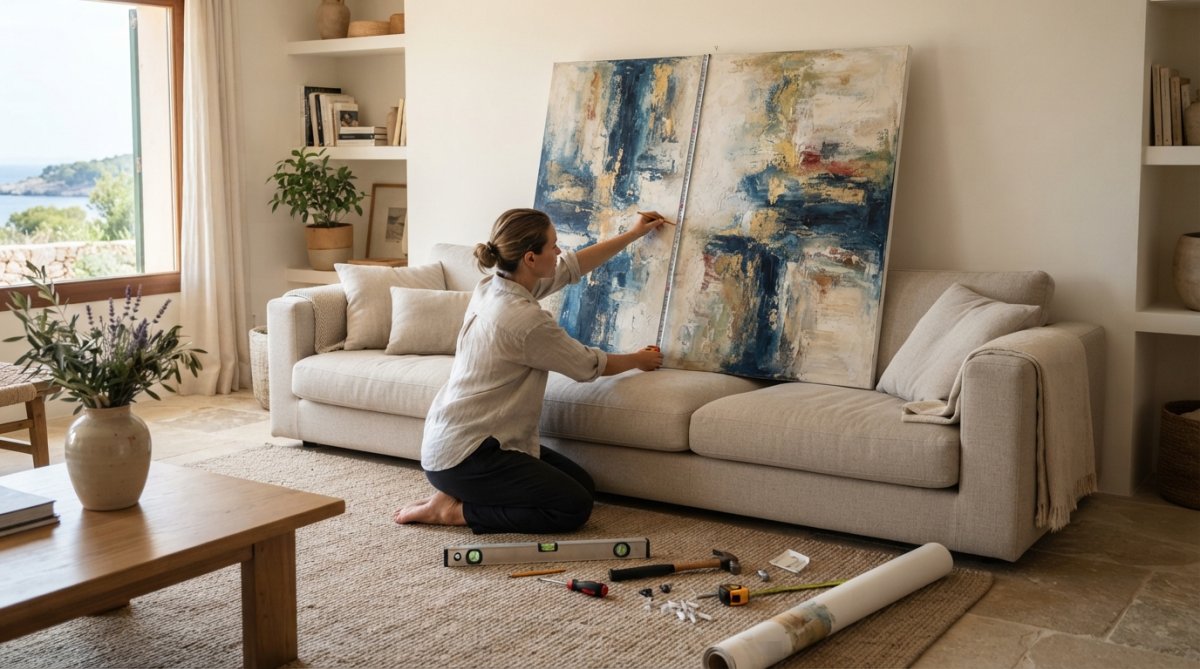
How to Display Large Abstract Canvas Art: Key Principles
The most common mistake is treating a large canvas like a small print, hanging it too high, too small relative to the wall, or in isolation. When you approach oversized wall art strategically, you reshape how people experience the entire space.
Understanding scale and proportion in your space requires measuring before you commit. Your artwork should occupy between 50-75% of the wall space above a piece of furniture like a sofa or console table. Standing in the room and holding up kraft paper cut to your canvas dimensions gives you the clearest sense of scale before installation. High ceilings support larger pieces, while intimate spaces benefit from medium-sized canvases that feel intentional rather than claustrophobic.
Creating visual balance with your focal point means understanding that a large abstract canvas interacts with furniture placement, color schemes, and architectural features. Consider sight lines from the room's entry point and seating area. The canvas should feel intentional, not accidental. If your room has multiple visual anchors (fireplace, windows, architectural details), your artwork should complement rather than compete with them.
Hanging Large Canvas Art Tips: Installation Essentials
The physical process of displaying large abstract canvas art requires the right tools and a methodical approach. For canvases over 75 cm (approximately 30 inches), you'll need more than a single nail.
Tools and hardware you'll need form the foundation of a secure, level installation. Identify whether you're hanging on drywall, plaster, or into wall studs, each requires different hardware.
Essential tools include:
- Stud finder (to locate wall studs for maximum support)
- Level (critical for getting your piece perfectly horizontal)
- Measuring tape (for precise placement calculations)
- Painter's tape (for marking placement without wall damage)
- Hammer or drill with appropriate bits
- Picture wire or hanging system rated for your canvas weight
- Wall anchors (toggle bolts or heavy-duty anchors for drywall)
Using painter's tape to mark your hanging points before drilling prevents costly mistakes.
Step-by-step hanging process follows a logical sequence that reduces errors. Most canvases hang from two points, but larger pieces benefit from three-point hanging systems for stability.
-
Measure and mark: Calculate the height where your canvas should hang (typically 145-152 cm from floor to center of artwork). Use painter's tape to mark the exact positions where hooks will go.
-
Locate studs: Use your stud finder to identify wall studs behind the tape marks. If studs align with your desired placement, use them for maximum support. If not, plan to use heavy-duty wall anchors.
-
Install hardware: Drill pilot holes at your marked positions. Install hooks or anchors, ensuring they're level with each other.
-
Attach hanging wire: Thread picture wire through the D-rings on your canvas frame. Create a slight sag in the wire (about 10% of the distance between attachment points) to distribute weight more evenly.
-
Hang and adjust: Carefully lift the canvas and position the wire on the hooks. Verify it's level using your level tool. Make micro-adjustments until perfectly horizontal.
Leveling and securing your artwork requires patience. Even a fraction of a centimetre off-level becomes visually obvious. Use your level tool on the canvas frame itself, not on the wall. For very large pieces, consider a French cleat system, two interlocking strips of wood that distribute weight across a wider wall area and make future adjustments simpler.
Displaying Large Artwork in Small Spaces
Small spaces demand strategic thinking. A large canvas can transform a compact room into something gallery-like or overwhelm it into claustrophobia.
Strategic placement to maximize impact means choosing walls carefully. Avoid centering large artwork on walls with doors or windows. Instead, place your canvas on the most visible wall from the room's entry point or primary seating area. In rooms under 14 square metres (approximately 150 square feet), limit your canvas to 100-125 cm (approximately 40-50 inches) maximum. In rooms 14-23 square metres (approximately 150-250 square feet), 125-175 cm (approximately 50-70 inches) works well.
Hanging height becomes critical in small spaces. Eye-level placement (145-152 cm from floor to center) prevents the artwork from feeling imposing or distant. In rooms with low ceilings (under 2.4 metres), hang your canvas slightly lower, around 137-142 cm.
Avoiding common spatial mistakes protects your investment. The biggest error is choosing a canvas too large relative to the room's proportions. Another frequent mistake is hanging large artwork above small furniture; a 150 cm canvas above a narrow console table creates visual imbalance. Lighting becomes even more critical in small spaces; consider picture lights or soft accent lighting that highlights your canvas without overwhelming the room.
Best Lighting for Abstract Art Display
Lighting transforms how viewers perceive abstract canvas art. The same piece can feel vibrant under one lighting scheme and flat under another.
Picture lights and accent lighting techniques create professional-quality display environments. Picture lights mounted directly above the canvas frame provide focused illumination that highlights texture and color. Use warm white LED bulbs (2700K-3000K color temperature) that approximate gallery lighting. Avoid harsh white or cool-toned LEDs, which flatten colors.
Accent lighting around the artwork creates a halo effect that makes the piece feel like a gallery installation. Wall sconces flanking the canvas or subtle uplighting creates visual drama and draws attention to your display.
Natural vs artificial light considerations require understanding how daylight affects your canvas. Direct sunlight can fade colors over time. If your canvas hangs near windows, use UV-protective glass or position the artwork where it receives indirect light. LED picture lights provide consistent illumination without heat damage. Balance artificial accent lighting with natural daylight so the canvas looks intentional in both conditions.
Framing Large Abstract Canvas Art: Design Choices
Whether to frame your large abstract canvas represents a fundamental design decision affecting both aesthetics and preservation.
Framed vs unframed considerations depend on your space's style, the canvas's condition, and preservation priorities. Unframed canvases create a modern, gallery-like appearance. Framing adds formality and protects canvas edges from damage. For large abstract canvases, frames should be minimal and understated; simple wood frames, thin metal frames, or floating frames complement oversized abstract pieces without competing for attention.
Canvas depth and mounting options affect how the piece interacts with your wall. Gallery-wrapped canvases (where the image wraps around the sides) create a finished appearance. Floating mounts hold the canvas several centimetres from the wall, creating shadow lines that add visual interest and make the piece feel sculptural. Floating mounts are particularly effective with accent lighting, as the gap creates dynamic shadows that enhance visual impact.
Planning Your Layout: Preparation Steps
Successful large canvas displays begin with meticulous planning. The installation takes an hour; planning prevents costly mistakes.
Using kraft paper templates and painter's tape gives you a risk-free way to test placement before committing.
-
Create a template: Cut kraft paper to your canvas's exact dimensions.
-
Tape to the wall: Use painter's tape to secure the kraft paper template to your wall in the proposed location. Step back and view it from different angles and distances.
-
Live with it: Leave the template up for at least 24 hours. View it in different lighting conditions, from your seating area, and from the room's entry point.
-
Adjust as needed: If placement feels off, move the template and repeat. Once satisfied, mark the hanging points through the kraft paper before removing it.
Eye-level placement and composition rules follow principles developed by museum professionals. The standard rule is to center artwork at 145-152 cm from floor to the piece's center point. This aligns with average eye level when standing. Above a sofa, slightly lower placement (137-142 cm) often feels more intimate. The goal is creating a natural sight line without tilting your head.
Consider how the artwork relates to furniture arrangement, architectural features, and other decorative elements. Your canvas should feel like the deliberate focal point, not an accident of placement.
Maintenance and Preservation of Your Display
Large abstract canvases represent significant investments. Proper maintenance preserves their appearance and longevity.
Protecting abstract textures and finishes requires understanding what you're protecting. Original hand-painted abstract work features unique surface qualities, brushwork texture, paint depth, and dimensional effects that are vulnerable to dust, moisture, and UV damage.
Dust accumulation dulls colors. Use a soft brush or microfiber cloth to gently remove dust every 2-3 months. Avoid water or cleaning solutions unless the canvas is sealed. Maintain consistent room temperature and humidity (ideally 40-55% humidity, 18-24°C temperature) to prevent canvas warping or paint cracking.
Avoid touching the painted surface directly. Oils from hands can leave marks and damage the paint layer. UV damage fades colors over time, particularly in direct sunlight. If your canvas hangs near windows, consider UV-protective glazing or position the artwork where it receives indirect light.
Rental-friendly display alternatives address the challenge of displaying large art in temporary spaces. Adhesive picture hanging strips rated for 11+ kg (approximately 25+ pounds) work well for canvases up to 100 cm. Damage-free mounting systems using tension rods or suction cups provide secure hanging without nails or adhesive. Leaning large canvases against walls or furniture creates a casual gallery aesthetic that requires zero installation.
Common Mistakes to Avoid When Displaying Large Canvas Art
Learning from others' errors accelerates your path to a stunning display.
The most frequent mistake is choosing a canvas that doesn't match the room's scale. Oversized artwork in a small room feels aggressive; undersized pieces in large rooms disappear. Spend time with your kraft paper template before purchasing.
Hanging too high ranks second. Most people hang artwork above eye level, creating visual distance and discomfort. Stick to the 145-152 cm standard unless your space's specific proportions justify adjustment.
Poor lighting makes even exceptional artwork look mediocre. Invest in picture lighting or accent lighting that highlights your canvas. Ignoring wall condition causes installation failures; identify your wall type before selecting hardware. Hanging artwork in isolation misses the opportunity to create intentional room design. Neglecting preservation allows beautiful artwork to deteriorate; dust regularly and protect from direct sunlight.
| Common Mistake | Why It Fails | How to Fix It |
|---|---|---|
| Canvas too large or small | Doesn't match room proportions | Use kraft paper template; test for 24 hours |
| Hanging too high | Feels distant and uncomfortable | Center at 145-152 cm from floor |
| Poor or no lighting | Artwork looks flat and dull | Add picture lights or accent lighting |
| Wrong wall hardware | Installation fails or artwork falls | Identify wall type; use appropriate anchors |
| Artwork in isolation | Feels accidental, not designed | Relate piece to furniture and room layout |
| No maintenance routine | Colors fade, dust accumulates | Dust monthly; protect from direct sun |
Displaying large abstract canvas art successfully combines technical precision with design intuition. The installation itself is straightforward once you understand the principles and use proper tools. The real skill lies in choosing placement that makes your space feel intentional and curated.
ART BY ALEXANDRA HOFVE creates hand-painted original abstract works designed to transform rooms with depth, color, and emotional resonance. Each piece is crafted to evoke feelings of security, peace, and strength, qualities that deserve thoughtful display. When you invest in authentic, original abstract artwork, proper hanging and lighting reveal the brushwork, texture, and authenticity that make these pieces special. Start with your kraft paper template, take your time with placement, and let your space tell the story your artwork deserves to tell.
Frequently Asked Questions
What is the best height to hang large abstract canvas art?
The standard eye-level placement for large canvas art is with the center of the artwork positioned at approximately 145 cm from the floor, roughly at average eye height when standing. For artworks above furniture like sofas or mantles, position the bottom edge 20-30 cm above the furniture surface. Adjust based on ceiling height and room proportions to maintain visual balance as your focal point.
How do you display large artwork in small spaces without overwhelming the room?
In smaller rooms, use your large abstract canvas as a statement piece rather than competing with other décor. Keep surrounding wall space clear to let the artwork breathe. Choose a single wall as your focal point and avoid gallery walls. Ensure adequate lighting to enhance the piece's visual weight without making the room feel cramped. Consider the canvas depth carefully; shallower mounting profiles work better in tight spaces.
Should large abstract canvas art be framed?
Unframed canvas allows the abstract textures and brushwork to take center stage, creating a contemporary aesthetic that works well for modern spaces. Framing adds formality and and can protect edges but may diminish the immediacy of hand-painted abstract work. Many collectors prefer displaying unframed canvas to showcase the artist's technique and authentic composition directly. Your choice depends on room style and whether you want to emphasize the artwork's tactile qualities.
What lighting techniques work best for displaying abstract art?
Picture lights mounted above the frame create professional, gallery-quality illumination that highlights texture and color depth. Accent lighting positioned at 45 degrees to the canvas reveals abstract textures without glare. Avoid direct overhead lighting, which flattens the artwork. Natural light is excellent but monitor for UV exposure and fading over time. Layered lighting, combining ambient room light with focused picture lights, creates visual interest and emphasizes your artwork as the focal point.
[EXTERNAL_LINK: Museum of Modern Art guide to displaying artwork at home | moma.org]
[EXTERNAL_LINK: Interior design principles for large-scale art display | architecturaldigest.com]
[EXTERNAL_LINK: Conservation guidelines for protecting canvas artwork from UV damage and environmental factors | americanconservation.org]
This article was written using GrandRanker