
Table of Contents
- How to Choose Original Abstract Art for Home: A Practical Guide
- Understanding Abstract Art Styles Explained
- Assessing Authenticity and Quality in Original Works
- How to Display Abstract Art in Your Space
- Sizing and Hanging Large Abstract Wall Art
- Buying Abstract Art Online Sweden: What to Verify
- Common Mistakes When Choosing Abstract Art
- Making Your Final Decision: How to Choose Original Abstract Art That Lasts
Last Updated: July 27, 2026
How to Choose Original Abstract Art for Home: A Practical Guide
Selecting art for your home is a meaningful investment, something you'll see daily that should reflect who you are and how you want to feel. This guide from ART BY ALEXANDRA HOFVE covers how to choose original abstract art with confidence. The challenge isn't a lack of beautiful work available; it's the opposite. Without a framework, you end up paralyzed by choice or settling for something that merely decorates. Research from the Journal of Environmental Psychology shows that the art you live with directly influences your mood and sense of well-being. Below, we'll examine what makes abstract work meaningful, how to assess authenticity, and how to ensure your selection works in your physical environment.
Understanding Abstract Art Styles Explained
Abstract art communicates through color, form, line, and composition rather than representing recognizable objects. Understanding the major categories helps you narrow your search and articulate what resonates with you.
Geometric vs. Organic Abstraction
Geometric abstraction relies on precise shapes, clean lines, and bold color blocking. It feels structured and conveys order and stability. Organic abstraction uses flowing forms, curved lines, and layered marks that suggest natural movement and spontaneity. Geometric pieces calm and organize; organic pieces energize and express. Consider what your space needs: a busy living room might benefit from geometric abstraction's visual rest, while a bedroom might welcome organic work's emotional depth.
Color Field and Expressive Abstraction
Color field abstraction focuses on color relationships and emotional response to hue, with minimal line or form. These pieces are profoundly affected by lighting conditions, the same painting feels different at dawn versus evening. Expressive abstraction prioritizes the artist's gesture and emotional intensity, with visible marks and obvious layering. These works benefit from close viewing, where you can see the texture and mark-making that gives them character.
Assessing Authenticity and Quality in Original Works
How do you verify that what you're purchasing is genuinely hand-painted and not a high-quality reproduction? The answer lies in understanding the physical markers of authenticity.
Hand-Painted vs. Printed: What to Look For
A true original has paint applied directly by the artist's hand. When examining whether a work is hand-painted, look for these indicators:
Texture and dimension. Original paintings have actual surface texture. Paint has thickness and catches light differently depending on viewing angle. Photographs of originals show visible brushwork and layering. Printed reproductions appear completely flat.
Visible brushwork or mark-making. Every artist has a distinctive hand. Look for variation in stroke, pressure, and color mixing that shows human inconsistency. Printed work has perfect mechanical consistency.
Certificate of authenticity. Legitimate artists provide documentation including the artist's name, work title, dimensions, date created, and medium. At ART BY ALEXANDRA HOFVE, each hand-painted original comes with clear documentation of authenticity.
Price point reality check. Original hand-painted abstract art has a baseline cost. If the price seems too low compared to similar work, it's likely a print. Originals require time, materials, and skill.
Ask directly. Reputable artists answer questions transparently about whether the piece is hand-painted, what medium was used, how long it took, and whether it's one-of-a-kind. Vague answers are a warning sign.
Artist Background and Creative Process
Understanding who created the work adds another layer to your decision. Research the artist's background, training, and what drives their practice. Artists who articulate their process tend to create more intentional work. Alexandra Hofve, for example, draws from personal experience and the creative environment of Mallorca, infusing each piece with emotional authenticity. Ask for process documentation, many original artists share images or video of work in progress, building confidence that the work is genuinely original.
| Verification Method | What to Look For | Red Flag |
|---|---|---|
| Texture & dimension | Visible brushwork, paint thickness, light reflection | Completely flat surface in all photos |
| Mark-making | Variation in stroke, pressure, color mixing | Perfect mechanical consistency |
| Documentation | Certificate with artist name, title, date, medium | No documentation or vague details |
| Artist background | Clear biography, training, artistic philosophy | Unknown or anonymous artist |
| Process transparency | Images of work in progress, artist statements | No information about creation process |
| Price alignment | Consistent with similar original work | Suspiciously low compared to market |
How to Display Abstract Art in Your Space
Choosing the right piece is only half the challenge. How you display it determines whether it transforms your room or gets lost in it.
Color Harmony and Room Integration
The most common mistake is selecting art based solely on how it looks online, then being shocked when it doesn't feel right in your actual space. Before purchasing, assess your room's existing color palette. What are the dominant colors? Is the space warm-toned or cool-toned? The abstract art should either complement this palette or intentionally contrast with it.
Three primary color relationships work well: Harmony through shared tones creates a cohesive, restful environment. Accent through contrast introduces a color not dominant in your room but complementary to the existing palette. Intentional bold statement works when the piece is large enough and positioned prominently enough to clearly anchor the space.
Lighting profoundly affects how colors appear. Natural light changes throughout the day; artificial light has color temperature that warms or cools the space. View images of your potential purchase under similar lighting conditions to your room.
Placement and Visual Weight Distribution
Where you hang the art matters as much as what you hang. The 57-inch eye-level rule is useful: the center of your art should be approximately 57 inches from the floor. However, if hanging above a sofa, the piece should sit higher so it's visible when seated. Maintain 8-12 inches of clearance above furniture.
Visual weight distribution matters in overall room composition. A large, dark, densely colored abstract piece anchors a space, typically above a sofa, bed, or console. Lighter, airier pieces work as secondary focal points. Balance top-heavy compositions with visual interest at other levels.
Sizing and Hanging Large Abstract Wall Art
Scale is one of the most difficult decisions when buying art online. A piece that looks perfect in a gallery might overwhelm your bedroom, or feel insignificant in a large living room.
Measuring Your Space and Choosing Scale
Start by measuring your wall and the distance from where you'll view the piece. Sit on your sofa and look at the wall; stand in the doorway and observe how the wall functions in the room's composition.
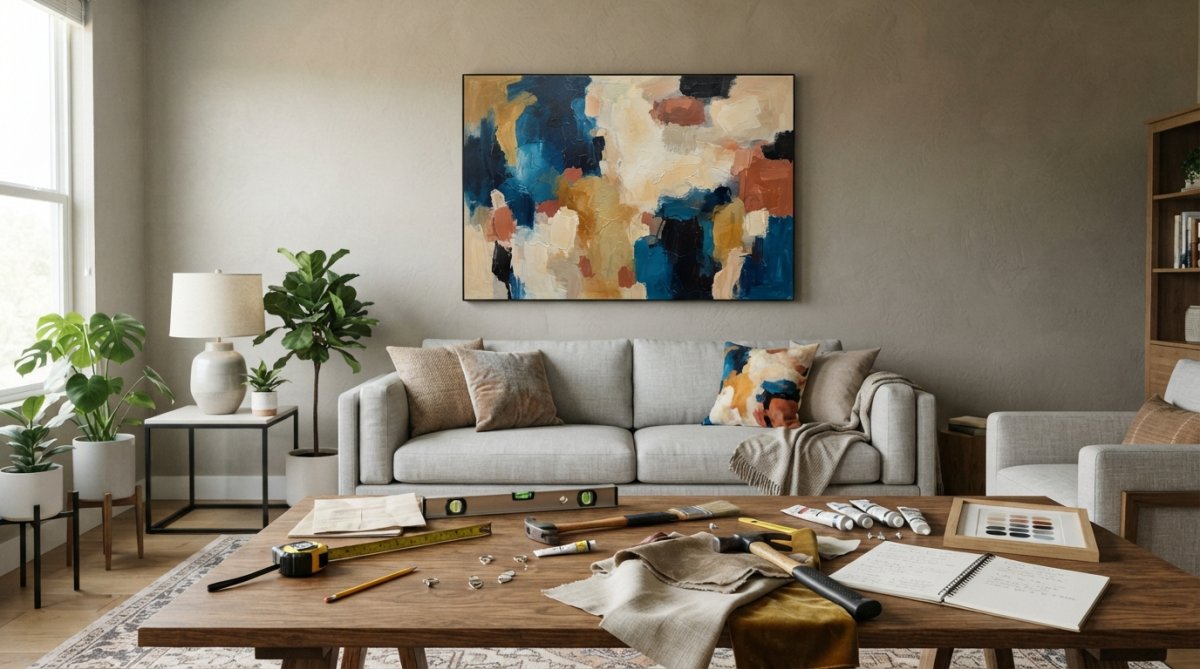
A general rule: the art should occupy 50-75% of the wall space above your furniture. If your wall is 10 feet wide and your sofa is 8 feet wide, your art should be roughly 4-6 feet wide. Larger pieces create more impact and often look more intentional. A 4x5 foot abstract painting makes a stronger statement than a 2x3 foot piece in the same space.
Consider the room's function. A bedroom can handle a smaller, more intimate piece; a living room typically benefits from larger work that serves as a focal point. When buying online, use your phone's camera to visualize scale by holding it up to the wall where the art will hang.
Installation and Wall Considerations
Different wall types require different hardware. Drywall requires anchors; plaster needs specialized fasteners; masonry requires a drill and masonry anchors. For original paintings, use picture wire and D-rings on the frame backing rather than direct fasteners through the canvas.
For drywall, toggle bolts or heavy-duty anchors hold better than standard plastic anchors, especially for large pieces. If your wall has studs, mounting directly into a stud is strongest. For plaster walls, avoid drilling if possible; use plaster anchors if you must. Double-fixing (using two anchor points) adds stability for large pieces.
Use a spirit level to ensure your piece hangs straight. For valuable originals, consider professional installation.
Buying Abstract Art Online: What to Verify
Purchasing original art without seeing it in person requires extra diligence. You're making a significant investment based on photographs and descriptions.
Photo Accuracy and Color Representation
The most common complaint from online art buyers is that colors look different in person than on screen. When evaluating photos, look for multiple images taken in different lighting conditions: natural light, warm artificial light, and cool artificial light. Single, heavily edited photos are a warning sign.
Ask for a photo in context, the art hanging in an actual room, not just on a neutral background. Request a close-up photo showing texture and brushwork, confirming the piece is hand-painted and showing execution quality.
Return Policies and Purchase Protection
Before purchasing, understand the seller's return policy. The best policies allow returns within 30 days, with the seller covering return shipping. Check whether the seller offers purchase protection through payment methods. If you use a credit card, you have chargeback protection. For significant purchases, consider insurance, shipping damage happens, and insurance protects your investment.
Verify the seller's reputation. How long have they been in business? Do they have reviews or testimonials? For established artists like Alexandra Hofve, a portfolio of completed commissions and satisfied customers provides confidence.
Common Mistakes When Choosing Abstract Art
Choosing based on trend rather than personal response. If you choose a piece because it's fashionable, you'll likely tire of it quickly. Ask yourself: "Will I still love this in five years?"
Ignoring your actual space. Imagine the piece in your specific space under your specific lighting before purchasing.
Underestimating scale. Most people buy art that's too small. A small piece in a large room feels timid. For a living room wall above a sofa, consider pieces at least 4 feet wide.
Prioritizing price over authenticity. Extremely cheap "original" art is usually not original. Invest in authentic pieces from artists you trust.
Buying without understanding the artist. Art created with intention carries different energy than art created for commercial purposes.
Failing to account for lighting changes. The same piece looks dramatically different under morning light, afternoon light, and evening artificial light. Ask the seller how colors shift under different lighting.
Making Your Final Decision: How to Choose Original Abstract Art That Lasts
Before committing, ask yourself these final questions:
Does this piece make you feel something? Art that transforms your space creates an emotional response. You might feel calm, energized, thoughtful, or inspired, but there should be genuine feeling.
Can you live with this long-term? Imagine seeing this piece every day for five years. Does that feel good?
Does it fit your space functionally? Can you hang it safely? Will it work with your existing décor?
Are you buying from a trustworthy source? Has the seller been transparent about authenticity, provided clear images, and offered reasonable return protection?
Does the price feel right? Original hand-painted abstract art should cost more than a print, but not so much that you feel buyer's remorse.
When all these factors align, emotional response, functional fit, trustworthy source, authentic work, and fair price, you've found the right piece.
Choosing original abstract art for your home is fundamentally about creating a space that reflects who you are and how you want to feel. The process requires more intentionality than buying mass-produced décor, but the reward is a room that genuinely speaks to you. ART BY ALEXANDRA HOFVE specializes in hand-painted original abstract works designed to evoke security, peace, and strength. Each work is crafted with visible brushwork, authentic emotion, and the creative energy of Mallorca infused into every canvas. When you're ready to invest in art that transforms your space with depth, color, and genuine character, original work from artists committed to authenticity makes all the difference.
Frequently Asked Questions
What should I consider when choosing original abstract art for my home?
When choosing abstract art, evaluate the artist's authenticity and creative process, assess how the piece's color palette and visual weight interact with your room's existing décor, consider the scale relative to your wall space, and verify that you're purchasing a genuine hand-painted original. Think about whether the work evokes an emotional connection and aligns with your long-term aesthetic vision rather than following temporary trends.
How do I know if abstract art is truly hand-painted and not mass-produced?
Genuine hand-painted originals show visible brushwork, texture variation, and subtle imperfections that distinguish them from printed reproductions. Request close-up photos or videos from the artist showing surface detail and paint application. Research the artist's background and creative process, authentic creators share their methodology and materials. Reputable platforms selling original abstract art provide documentation of the work's provenance and artist credentials.
What size abstract wall art should I choose for my space?
Measure your wall and furniture scale, oversized art typically works best above sofas or as focal points in open walls. A general guideline: the artwork should occupy about 50-75% of the wall space above furniture. Consider the room's visual weight distribution; larger abstract pieces can anchor a space, while smaller works suit gallery wall arrangements. Account for viewing distance; pieces meant to be viewed up close need different scale than those seen from across a room.
Should abstract art match my room's color scheme, and how do I verify color accuracy when buying online?
Abstract art doesn't need to match your décor exactly, complementary or contrasting colors can create visual interest and depth. However, ensure the piece harmonizes with your overall aesthetic. When buying abstract art online Sweden, request multiple photos taken in different lighting conditions and ask the seller about their photography process. Compare images on multiple devices and ask specific questions about undertones and finish (matte, glossy). Check the seller's return policy to protect your investment if colors appear different upon arrival.
This article was written using GrandRanker